
It’s 8:15am. School starts at 8:45. Your child still isn’t dressed. You can’t find their shoes. Someone is crying—might be you, might be them, honestly hard to tell at this point.
You try the visual schedule. Doesn’t work. You try rewards. Doesn’t work. You try consequences. Everyone just ends up angrier.
Mornings feel like going to battle every single day.
If your mornings are chaos, it’s not because you’re doing it wrong. It’s because neurodivergent brains struggle with the exact skills mornings demand: sequencing tasks, managing time, transitioning between activities, handling sensory input (socks! brushing teeth!), and regulating emotions when things don’t go smoothly.
Most morning routine advice assumes skills your child doesn’t have yet.
Here are 5 morning routines for neurodivergent kids that actually work—because they match your child’s brain, not fight against it.
Why Mornings Are Especially Hard
Mornings require basically every executive function skill at once:
- Working memory: Remember the sequence (get dressed, brush teeth, pack bag)
- Task initiation: Start each step without endless reminders
- Time awareness: Know how long things take, adjust when running late
- Cognitive flexibility: Handle when something doesn’t go as planned
- Emotional regulation: Stay calm when rushed or frustrated
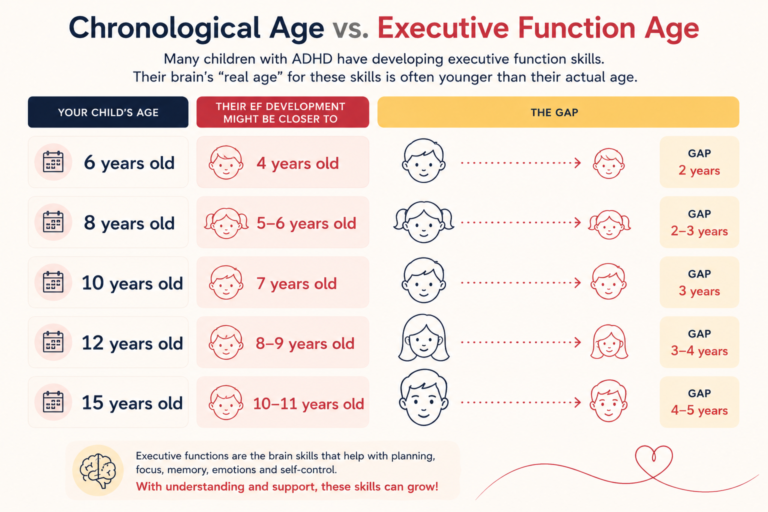
For a child with ADHD, whose executive function development can lag several years behind their chronological age, this is like asking them to juggle while riding a unicycle. Many other neurodivergent children face a similar mismatch between what’s expected of them in the morning and what their developing executive function can actually deliver. (If you’re wondering whether what you’re seeing goes beyond typical development, Is This Normal? walks through it age by age.)
Plus sensory challenges: tags that itch, toothpaste texture that gags, bright lights when groggy, siblings being loud.
No wonder mornings fall apart.
The 3 Principles of Routines That Work
Before strategies, principles. These apply regardless of which approach you try:
1. Visual > Verbal
Your child’s working memory struggles to hold verbal instructions. “Get dressed, brush your teeth, pack your bag” becomes a jumbled mess in their head.
Visual supports—charts, checklists, pictures—bypass working memory. The routine is external, not stored internally. This isn’t a crutch; it’s accommodating a real neurological difference.
2. Flexible > Rigid
The goal is out the door, not perfect execution. If they eat breakfast in the car, that still counts. If hair gets brushed at school, that’s okay. Some battles aren’t worth fighting at 8am.
Rigid routines break. Flexible routines bend.
3. Rewarding > Punishing
Notice what’s working, not just what’s not. Punishment doesn’t build skills—it builds resentment and shame. Simply acknowledging effort helps: “You got your shoes on without me reminding you. That’s the kind of morning we’re building toward.”
5 Morning Routines for Neurodivergent Kids
Not every approach works for every child. Try one for two weeks before deciding. Here are five options:
1. The Visual Schedule System
Best for: Kids who need structure and predictability
What it is: A checklist or picture chart showing every step of the morning routine, posted where they can see it.
Why it works: Takes the “remembering” out of their brain and puts it on the wall.
2. The Backwards Planning Method
Best for: Time-blind kids who don’t sense urgency
What it is: Start with “out the door at 8:40” and work backwards, building in buffer time. Post the timeline visibly. Use timers for each transition.
Why it works: Makes time concrete and visual instead of abstract.
3. The Choice Menu
Best for: Oppositional or demand-avoidant kids
What it is: Choices within structure. The tasks are non-negotiable, but the order and method are flexible. “You need to do: get dressed, eat breakfast, brush teeth. Which do you want to do first?”
Why it works: Reduces power struggles by giving autonomy.
4. The Body-First Routine
Best for: Sensory-seeking kids who need regulation before function
What it is: Start the morning with physical regulation activities (trampoline, jumping jacks, dance party) before expecting anything else.
Why it works: Many neurodivergent kids need sensory input to “wake up” their regulatory system.
5. The Minimal Morning
Best for: Overwhelmed families who need to reduce friction immediately
What it is: Only absolute essentials happen in the morning. Lay out clothes night before. Pack bag night before. Breakfast is grab-and-go. Morning routine: bathroom, clothes, out the door. That’s it.
Why it works: When mornings are consistently terrible, reduce demands until you have success, then add back gradually.
When It’s Not Working
“Worked for a week, now it doesn’t”
Novelty wore off. For some neurodivergent children — especially those with ADHD — the brain responds strongly to novelty and then habituates quickly. Time to refresh—new visual chart, different approach.
“They refuse to follow any routine”
You might be in a power struggle. Step back: Is this about routine or control? The Choice Menu approach might help.
“Different at different houses”
Routines need to transfer between homes. Keep them as similar as possible, but accept some variation is inevitable.
This Can Get Better
Our mornings used to be a war zone. Every. Single. Day.
We use a combination now: visual checklist on the bathroom mirror, everything laid out the night before, and 10 minutes of trampoline time first thing. It took trial and error. But when we combined the approaches that matched his actual challenges, mornings became survivable.
He’s 14 now. He still uses the visual checklist sometimes. The trampoline time is non-negotiable—if he skips it, the whole morning falls apart. We’re okay with that. It works.
Your mornings can get better too. Not perfect. But better. And honestly, “better” is good enough.
Want Routines Customised to Your Child’s Brain?
Get your Personalised Parenting Plan — $42/month and get:
✓ Courses built around your child’s executive function profile
✓ Age-specific routine templates for morning, homework, bedtime
✓ A community of NZ parents figuring this out together
Want to know what’s actually going on for your child?
Start free