
Your child is three and can’t sit through circle time. The other kids can.
Your child is seven and melts down over homework every night. Their friends don’t.
Your child is twelve and has no friends. Everyone else seems to navigate social situations just fine.
You keep being told “they’ll grow out of it” or “that’s just their personality” or “all kids are like that sometimes.” But your gut says something else. Something’s different. You just don’t know if different means “needs help” or just “different.”
If you’re here reading this, your gut is already telling you something. That instinct matters.
But not every difference needs diagnosis or intervention. Some neurodivergent traits are just… how your child’s brain works. They’ll need support and understanding, but not fixing.
Here’s how to tell the difference between neurodivergent variation and signs that evaluation makes sense.
Developmental Differences vs. Delays
Developmental differences are when your child does things in their own way or on their own timeline, but they’re still progressing and learning. They might learn to read early but struggle with handwriting. Excel at building with Lego but can’t follow social rules.
Developmental concerns are when your child is falling further behind, struggling significantly, or suffering. The gap between them and peers is widening, not narrowing. Daily life is consistently difficult.
The key question isn’t “Is my child normal?”
It’s: “Is my child happy and managing? Or struggling and suffering?”
A child who develops differently but thrives doesn’t necessarily need intervention. A child who is struggling needs support, regardless of whether they meet diagnostic criteria.
What to Watch For by Age
Ages 2-5 (Early Childhood)
Within typical neurodivergent variation:
- Intense interests that come and go
- Preference for parallel play (playing alongside rather than with)
- Big feelings and slower emotional regulation development
- Needing more preparation for transitions than peers
Consider evaluation when:
- Speech significantly delayed without catch-up
- Can’t participate in group activities at all despite support
- Aggression or meltdowns that endanger safety
- No interest in people/connection (not just preference for alone time)
- Regression—losing skills they previously had
Ages 6-10 (Middle Childhood)
Within typical neurodivergent variation:
- Homework takes longer than peers
- Organization doesn’t match age expectations
- More emotional than classmates
- Struggles with friendships but has some connection (more on what’s really going on in When Making Friends Is Hard)
- Needs more parental support than peers
Consider evaluation when:
- Academic performance declining despite intelligence
- Consistent school refusal or extreme anxiety
- No friendships and increasing isolation
- Daily meltdowns that affect family function
- Your child is telling you they’re struggling
Ages 11-14 (Early Adolescence)
Within typical neurodivergent variation:
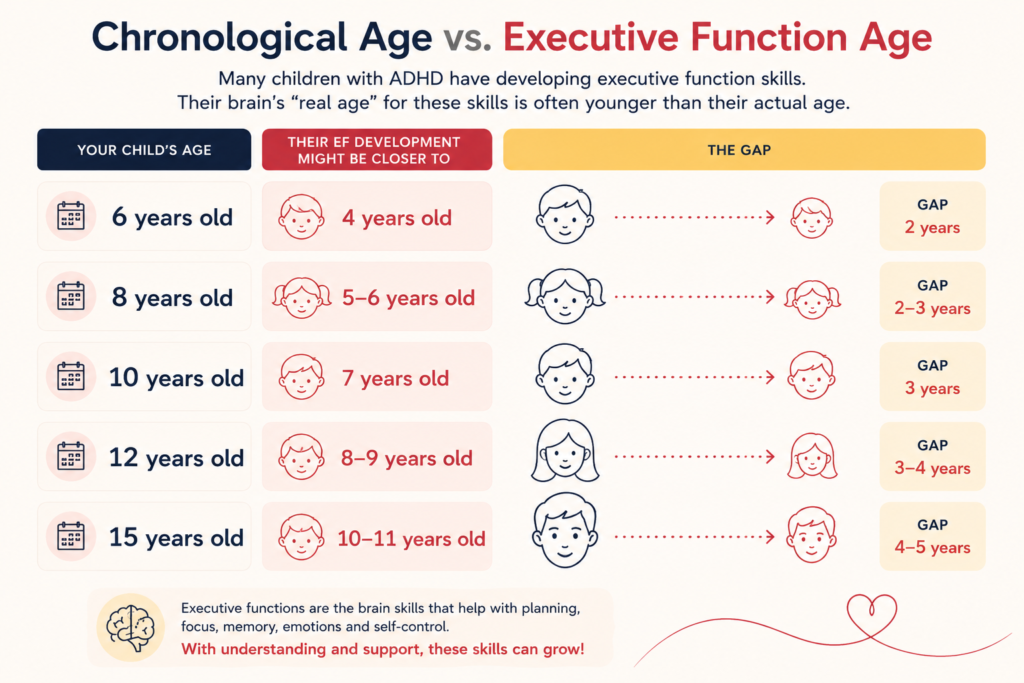
- Executive function still noticeably behind peers
- Emotional intensity during puberty
- Social navigation harder than for peers
- Prefers different social styles (smaller groups, one-on-one)
Consider evaluation when:
- Gap between capacity and expectations widening significantly
- Mental health concerns emerging (anxiety, depression)
- Self-esteem consistently low
- Self-harm thoughts or behaviors
- Complete social isolation
How Neurodivergence Presents Differently in Girls
Girls with ADHD and autism are often missed because their presentation differs from the stereotypical picture:
- Masking: Copying social behaviors to fit in (exhausting but effective)
- Internalising: Anxiety and depression rather than hyperactivity
- “Good” behavior: Struggling internally but keeping it together at school
- Social camouflage: May have friends but find socialising exhausting
Girls often don’t get identified until adolescence or adulthood, when demands exceed their ability to mask. These patterns also apply to non-binary children — anyone whose presentation doesn’t fit the “classic hyperactive boy” picture may be missed.
If your daughter (or any child who doesn’t fit the standard picture) is anxious, perfectionistic, socially exhausted, or falling apart at home while managing at school—consider evaluation even if they don’t “look” ADHD or autistic.
(Wondering about the brother or sister of an already-diagnosed child? Supporting Siblings When One Child’s Needs Dominate covers how neurodivergence can look completely different within the same family.)
Red Flags That Need Immediate Attention
These require immediate professional support, not “wait and see”:
- Expressing thoughts of self-harm or suicide
- Harming themselves or others
- Complete withdrawal from all activities and people
- Sudden dramatic changes in behavior
- Talking about not wanting to exist
If you’re seeing these signs, contact your GP urgently, call Healthline (0800 611 116), or take your child to the emergency department.
When my son told me he thought the world would be better without him, that wasn’t a “let’s evaluate this” moment. That was a crisis. We got help that day.
Trusting Your Gut
I wish I’d trusted my gut sooner.
Teachers said he was fine at school. Doctors said to give it time. I could see something was different, but I kept second-guessing myself.
Meanwhile, he was suffering.
Your instinct about your child matters. You know them better than any checklist or screening tool. If your gut says something is off, pursue it. Getting evaluation isn’t labelling your child as broken. It’s getting information that helps you support them better.
Want to Understand Your Child’s Brain Better?
OWLS is included in your Personalised Membership — $42/month:
✓ Clear picture of your child’s executive function strengths and challenges across 11 domains
✓ A Personalised Parenting Plan built around their profile
✓ Starting point for understanding how their brain actually works
This isn’t diagnosis — it’s information. Information that helps you support your child more effectively.
Want to know what’s actually going on for your child?
Start free